



1. Model Positioning & Background
Mazda3 (marketed as Axela in China) is a global strategic compact car under Mazda. First launched in 2003, it has gone through four generations of iteration. The fourth-generation (BP platform) debuted globally in 2018 and was domestically produced in China (by Changan Mazda) in 2019, with the 2026 model being a mid-cycle facelift optimized version. It is a benchmark sedan that perfectly integrates Mazda’s Kodo: Soul of Motion design language and Skyactiv Technology, offering both sedan and hatchback body styles. It balances sporty driving dynamics with family practicality, making it a popular choice in the global and Chinese compact car markets, as well as a high-resale-value model for used-car exports to Russia, the Middle East, and Southeast Asia. By the end of 2025, the global cumulative sales of the Mazda3 had exceeded 6 million units.
2. Exterior & Interior Space (2026 Model)
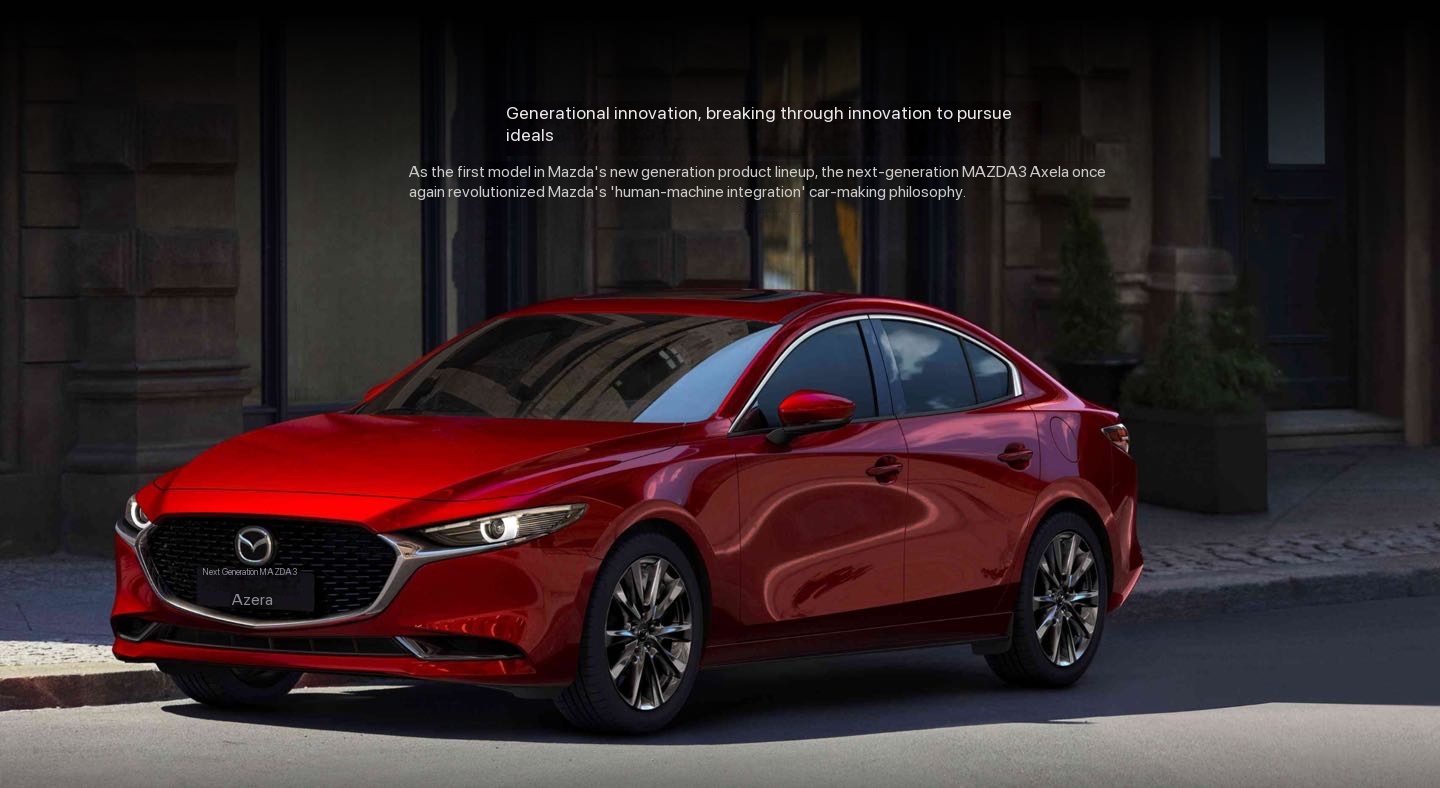
- Exterior: Featuring the Kodo 2.0 design language, it has a shield-shaped blacked-out grille paired with eagle-eye LED headlights, and sleek, low-slung body lines. Higher trims are available with 18-inch glossy/matte alloy wheels, with Soul Red Crystal as the brand’s iconic paint color. Both sedan and hatchback layouts are offered. The rear of some versions uses the “MAZDA” letter badge instead of the traditional logo—the hatchback version is more sporty, while the sedan version balances business and family use.
- Interior & Space: A minimalist and symmetrical driver-centric cockpit, following the “less is more” aesthetic, with extensive soft-touch materials and exquisite stitching. Standard 8.8-inch central display (10.25-inch for higher trims), supporting wireless CarPlay/CarLife. High-end trims come with a fully digital instrument cluster, HUD head-up display, leather seats, and heated seats. The wheelbase is 2726mm, offering sufficient rear legroom for family use. The trunk volume is 444L for the sedan and 358L for the hatchback, with foldable rear seats to expand loading capacity.
3. Powertrain & Performance (Key Market Configurations)
表格
| Market | Powertrain | Max Power/Torque | Transmission | Drivetrain | WLTC Combined Fuel Consumption |
|---|---|---|---|---|---|
| China | 1.5L Skyactiv-G NA; 2.0L Skyactiv-G NA | 1.5L: 117 hp/148 N·m
2.0L: 158 hp/202 N·m |
6-speed automatic (Skyactiv-Drive) | FWD | 1.5L: ~5.8 L/100km
2.0L: ~6.2 L/100km |
| North America | 2.5L Skyactiv-G NA; 2.5T Skyactiv-G Turbo | 2.5L: 186 hp/252 N·m
2.5T: 250 hp/434 N·m |
6-speed automatic | FWD/Optional i-ACTIV AWD | 2.5L: ~7.0 L/100km
2.5T: ~8.1 L/100km |
Note: The 2.5T and AWD versions are not available in China. Diesel versions were previously offered in Europe; gasoline models are the mainstay in 2026, with 48V mild-hybrid variants being rolled out in some regions.
4. Safety & Driving Dynamics
- Passive Safety: Skyactiv-Body high-rigidity frame with 1800MPa ultra-high-strength steel in key areas. All trims come standard with 6 airbags (front dual airbags, front/rear side airbags, and curtain airbags), with knee airbags available as an option on high-end trims.
- Active Safety: Standard i-ACTIVSENSE advanced safety suite, delivering Level 2 ADAS, including full-speed MRCC adaptive cruise control, SBS Smart Brake Support, LDWS Lane Departure Warning, BSM Blind Spot Monitoring, RCTA Rear Cross-Traffic Alert, and 360° surround-view camera.
- Driving Dynamics: GVC Plus (G-Vectoring Control Plus) for enhanced cornering stability, SEB butterfly-shaped 仿生 rear suspension for improved comfort and handling, MacPherson front suspension and multi-link rear suspension. Precise steering and sport-tuned chassis maintain the iconic “Jinba Ittai (Car and Driver as One)” driving experience.
5. Pricing & Pros/Cons (March 2026 China Market)
- Official price range in China: 115,900–169,900 RMB, with dealer discounts available; North American starting price is around US$24,550 (2026 model).
- Pros: Precise handling, distinctive design, proven reliability, moderate maintenance costs, strong resale value.
- Cons: Tight rear headroom for tall passengers; fewer high-tech features compared to domestic Chinese brands in the same price segment; no pure electric variant currently available.
6. Global Variants
Left-hand-drive and right-hand-drive versions are offered to adapt to different global markets. The sedan version targets the Asian and North American family markets, while the hatchback version is more popular in Europe and Japan. Right-hand-drive models are supplied to Japan, Australia, New Zealand, etc., making the Mazda3 well-suited for used-car exports worldwide.